In the development of scented products, the debate often arises: should pure essential oils or synthetic fragrances be used?
Many professionals believe it's a binary choice. However, at Olfacta Labs, we approach this issue from a scientific perspective. The answer to an excellent product almost always lies in its hybrid composition. Understand why the union between natural and synthetic ingredients is the gold standard in technical perfumery.
Essential Oils: The Soul and the Complexity
Essential oils are extracted directly from plants, roots, and flowers. These oils possess a "soul" and a complexity that science is still struggling to perfectly replicate.
Advantage: Olfactory richness and perceived value for the consumer.
The Professional Challenge: They are extremely unstable. The aroma of a lavender harvest can vary drastically from year to year, which is a problem for those who need to standardize a batch of products. Furthermore, many essential oils contain natural allergens in concentrations that are difficult to control.
Synthetic Fragrances: Precision and Safety
Contrary to what the term might suggest, high-quality synthetic molecules are created in the laboratory to isolate the best that nature has to offer, eliminating impurities.
Advantage: Stability and reproducibility. They allow you to create notes that don't exist in nature in an extractable form (like the smell of "sea air" or certain fruits).
The Professional Challenge: They demand high technical rigor. This is not about "cheap chemistry," but about molecules designed to be safe, hypoallergenic, and sustainable.
Hybrid Science: The best of both worlds
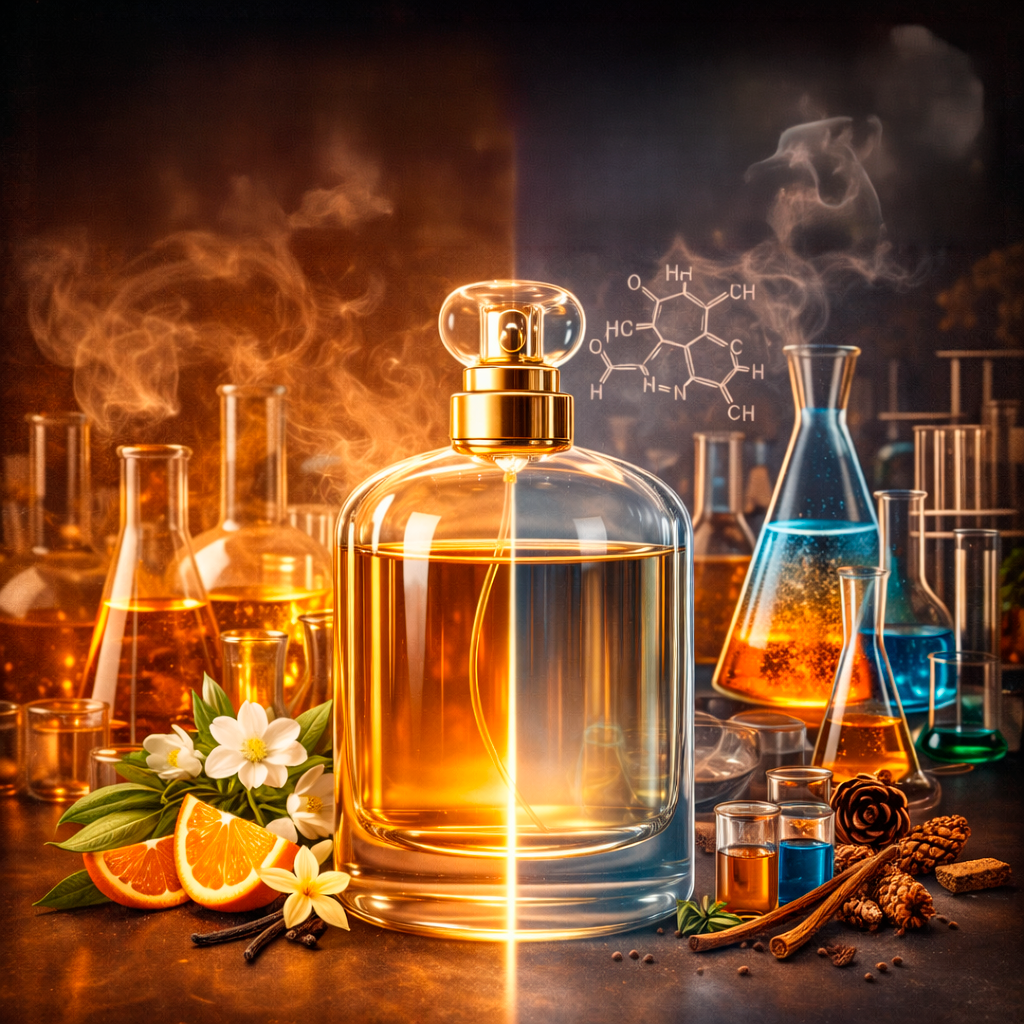
At Olfacta Labs, we argue that hybrid compounding is the superior solution for the professional market. Why?
Technical Performance: The essential oil provides the "natural signature," while the synthetic molecules ensure that the aroma remains stable for months on the shelf.
Safety and Compliance: Through laboratory synthesis, we are able to maintain the desired olfactory profile, ensuring that the final product meets IFRA standards, reducing the risk of allergic reactions in the end consumer.
Sustainability: Many natural raw materials are at risk of extinction or require devastating water consumption. Biotechnology allows us to replicate these aromas without harming the ecosystem.
Repeatability: The Critical Factor for the Manufacturer
For anyone selling a product, variation is the enemy. If a customer buys a cream or a candle today, they expect the next one to have exactly the same scent. Olfacta's laboratory science allows the synthetic component to "hold in" the natural variations of the oils, guaranteeing the consistency of each batch that leaves their studio or factory.