
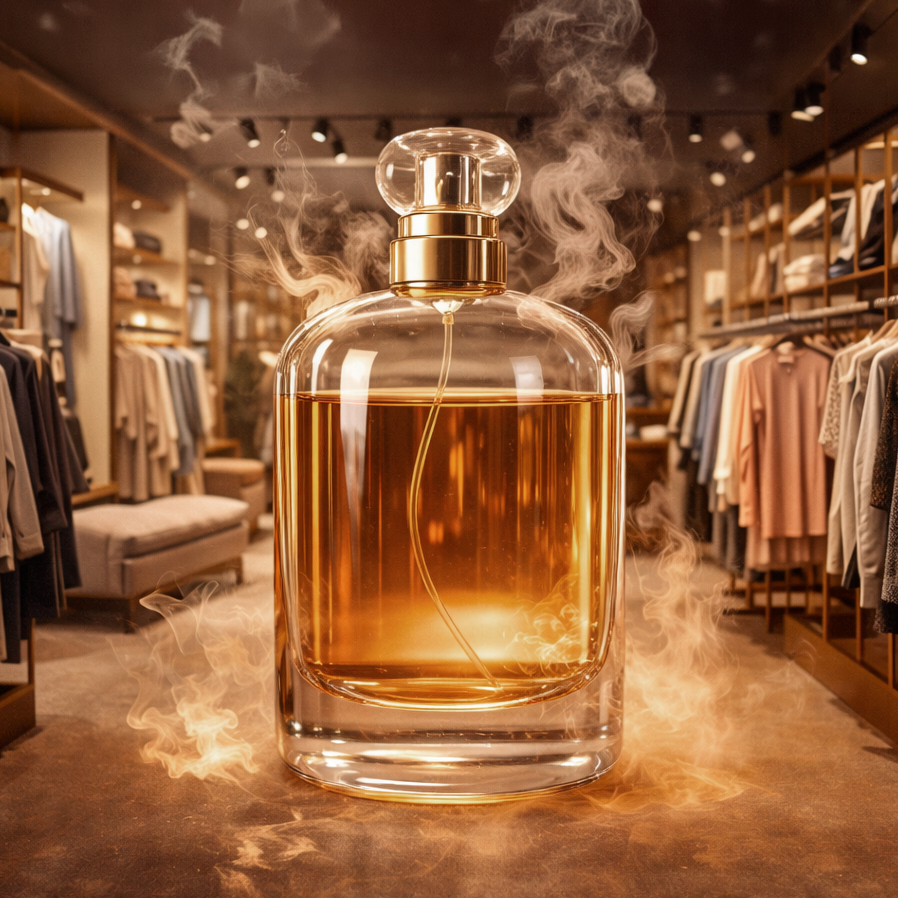
For a perfumer, the success of a fragrance is not measured solely by its scent in the bottle, but by how it behaves in the air. Why do some formulas fill a room with elegance, while others become suffocating or, conversely, disappear quickly? The answer lies in the Mathematics of Diffusion. At Olfacta Labs, we treat each scent as an equation of density and volatility, ensuring that your final product delivers the expected performance.
Volatility: The speed of molecules
Diffusion is governed by the rate of evaporation of molecules. In technical perfumery, we divide the components by their "speed":
Light Molecules (Citrus, Green Notes): They have rapid diffusion and high energy. They are the first to "travel" through space, but also the first to dissipate.
Heavy Molecules (Woods, Resins, Vanilla): These are dense and slow-moving. They have a lower evaporation rate, which gives them the power to fix and remain.
Correct mathematics balances these speeds so that the perception of the aroma is constant, and not a momentary burst followed by emptiness.
Density and Sensory Saturation
There's a common mistake in product development: believing that "more concentrated" means "better." However, excessive density of certain raw materials can cause what we call sensory overload.
When a formula is mathematically too dense for its intended purpose (for example, a room spray with too many heavy base notes), the molecules "fall" instead of floating. The result is a product that stains surfaces and does not effectively scent the air.
The Coefficient of Expansion: The aroma and volume of space
At Olfacta Labs, we help professionals understand the expansion coefficient of our fragrances.
Intimate spaces (e.g., bedroom candles, facial cosmetics): Require controlled diffusion and more subtle notes.
Large Spaces (e.g., diffusers for lobbies or large areas): Require formulas with greater "projection," where the molecular structure is designed to withstand air currents and maintain integrity.
Why is the solvent part of the equation?
The mathematics of diffusion depends not only on the aroma, but also on the vehicle (solvent) used. A high-quality solvent at Olfacta Labs is chosen to optimize the surface tension of the mixture. This ensures that, whether through natural evaporation (reeds) or spraying, the fragrance fragments into microscopic particles that defy gravity and distribute evenly.